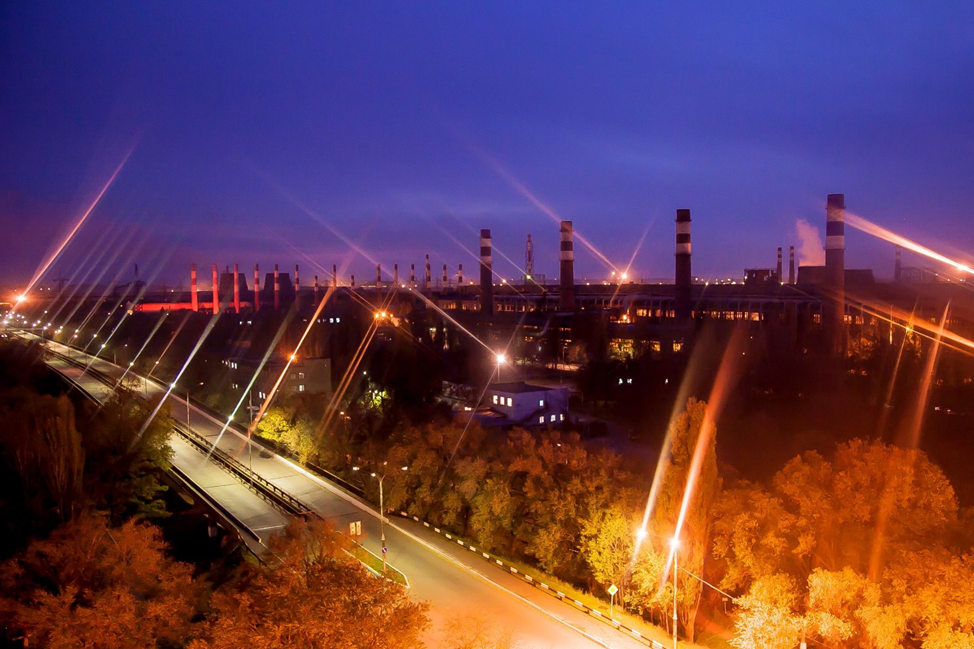
ArcelorMittal Kryvyi Rih celebrated its 92nd birthday.
On 4 August, ArcelorMittal Kryvyi Rih celebrates its 92nd birthday. For the fifth consecutive year, steelmakers and miners are celebrating this occasion amid war. Disrupted ties with customers, extremely complex logistics, astronomical energy prices, blackouts, and staffing and raw-material shortages. For the fifth year, the company is operating at a loss. The priority now is to hold out and preserve the enterprise. Yet despite all this, our people carry out large-scale repairs, replace equipment and utilities, restore facilities destroyed by the enemy and even set production records.
The Metalurh newspaper recalls the principal achievements of the past year — from one anniversary to the next.
Resilience is what defines us
In March 2026, employees of the BOF Shop at ArcelorMittal Kryvyi Rih set a record for the service life of a BOF lining. Lining durability is measured by the number of steel heats produced by the BOF between relinings. This is an important achievement, since the unit’s productivity and the cost of steel depend on the durability of the refractory lining, which protects the BOF against high temperatures (an average of 1640 degrees Celsius), chemically active substances and mechanical damage.
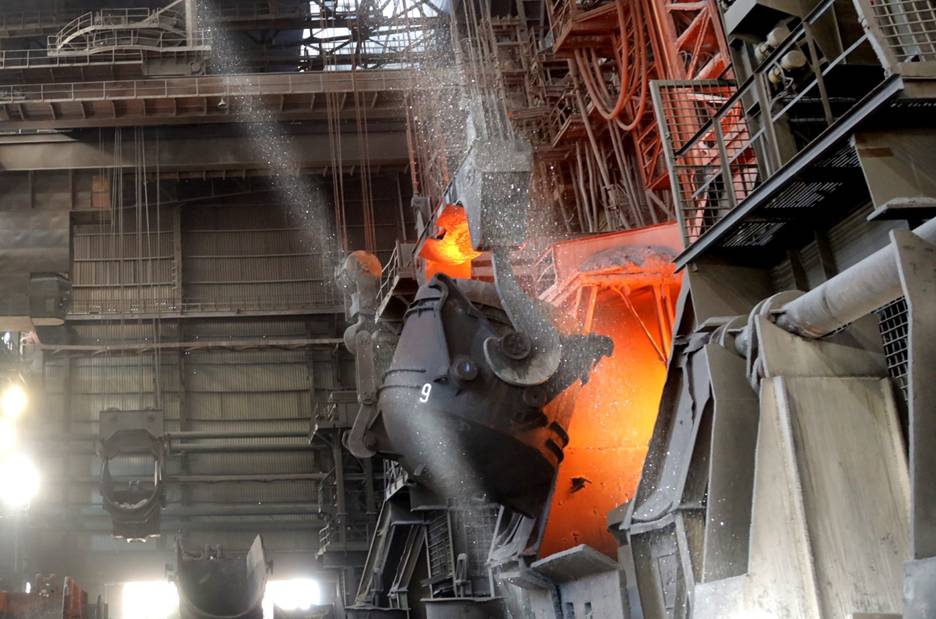
The previous record had stood for almost 13 years and was ultimately broken by a substantial margin — 5589 heats compared with 4934 in 2013. Work to increase service life is ongoing. Alongside employees of the BOF Shop — Volodymyr Sinchenko, Dmytro Koval, Mykola Starodubov, Dmytro Vasyliev and many others — specialists from the Technical Department, Serhii Vyshynskyi, Maksym Fedoruk, Roman Sukhomlyn and their colleagues are working on this. The record was therefore the achievement of a strong team.
An important component of this work is the search for high-quality refractories capable of withstanding destructive factors to the greatest possible extent. According to Maksym Fedoruk, Head of the Technical Division (Refractory Materials) of Technical Department, the specialists succeeded in selecting suitable materials for our BOFs. Timely lining scans were also of great importance for durability, while high-quality gunning repairs after the wear limits had been reached made it possible to maintain the lining in a serviceable condition until the end of the campaign.
The idea of air-and-droplet cooling for the BOF’s cone section, proposed by Dmytro Vasyliev, Head of the BOF Shop, worked exceptionally well. Volodymyr Sinchenko, Head of the BOF Section, noted that proper converter operation, ensured by a highly qualified team, is of great importance for high durability.
Battery No. 5 back in operation
On 22 October 2025, after a prolonged interruption, coke-oven battery No. 5 of Coking Shop No. 1 at ArcelorMittal Kryvyi Rih produced its first coke. 485 days had elapsed since the battery’s emergency shutdown.
On 23 June 2024, Kryvyi Rih came under another missile attack. Energy facilities were hit, resulting in a blackout. As a result, the machine hall in the Coking Shop stopped. Consequently, coke-oven battery No. 5, whose chambers were undergoing the coking process at the time, sustained critical damage that put it out of operation for a long period.
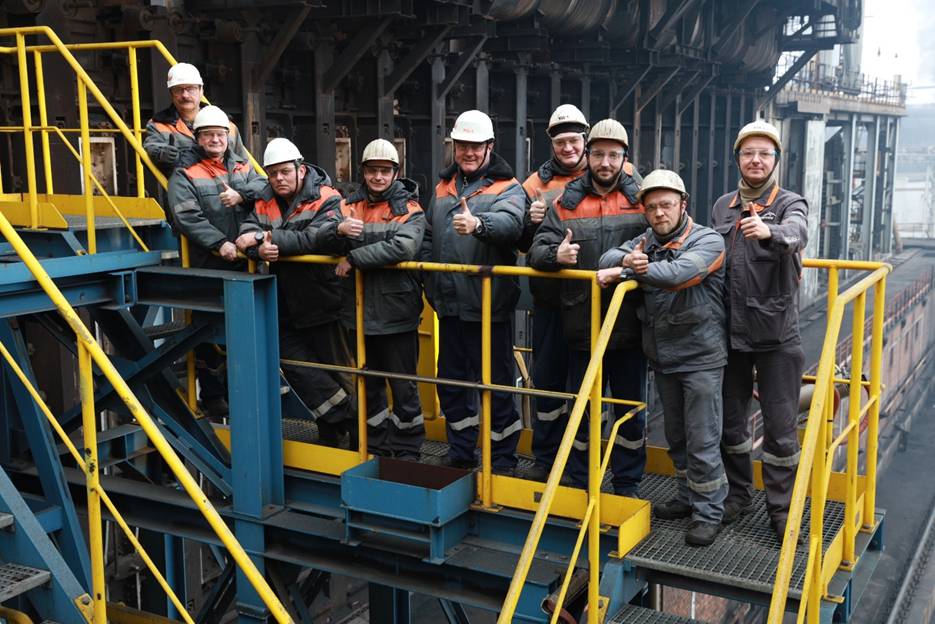
Coke-oven battery No. 5 is a complex set of equipment, so preparations for the repair were extremely thorough. The specialists identified the equipment required, found where it could be purchased, conducted tenders, waited and ultimately received everything necessary. Meanwhile, the coke-oven battery was maintained in hot-idle mode pending restoration. The repair was carried out by employees of a contracting organisation under the close supervision of our specialists.
During the repair, the stamping-charging-pushing machine and the battery-top servicing machine, which had sustained significant damage, were restored. Electrical and cable products and jib cranes were installed, and the stamping section of the SCPM was repaired from the zero elevation. The charge collection hoppers, stamping box, pallet, all mechanisms and electronics, and so forth — everything was restored from scratch. A section of the gas collector, its valve boxes, the reinforcing columns of the coke ovens, door frames, as well as nitrogen, oil and barillet-water pipelines were replaced.
“For our team, the repair of COB No. 5 was both a challenge and an opportunity to gain unique experience,” noted Anatolii Kolupaiko, Head of Coking Shop No. 1 of the Coke Plant. “It is known that COB Nos. 5 and 6 were built and commissioned by German specialists. We were responsible for operating the equipment. Now, following the repair, we have studied every nuance of our equipment. Many thanks to everyone who participated in this comprehensive repair: the investment team, Process Control System specialists, process engineers, and those who carried out equipment adjustment and hot testing. Everyone worked towards a single result, and we succeeded.”
A new milestone for the open pit
A large-scale project to install a dewatering system was implemented at Open Pit 2-bis of the Mining Department’s Open Mining Department.
A dewatering system is a set of equipment and structures used to pump water out of an open pit. An open pit cannot operate without it. As Dmytro Shvets, Project Manager of the Mining Department Project Implementation Service, explained, water is collected in an artificial basin called a sump and is then lifted through water-main pipes by pumps. It was this water main that was replaced during the project. It consists of two branches, with a total pipe length of 5 kilometres and 100 metres. Moreover, it was laid not over level ground, but across terrain resembling a mountainous landscape. This is exceptionally difficult and hazardous work, which was also carried out in an operating open pit.
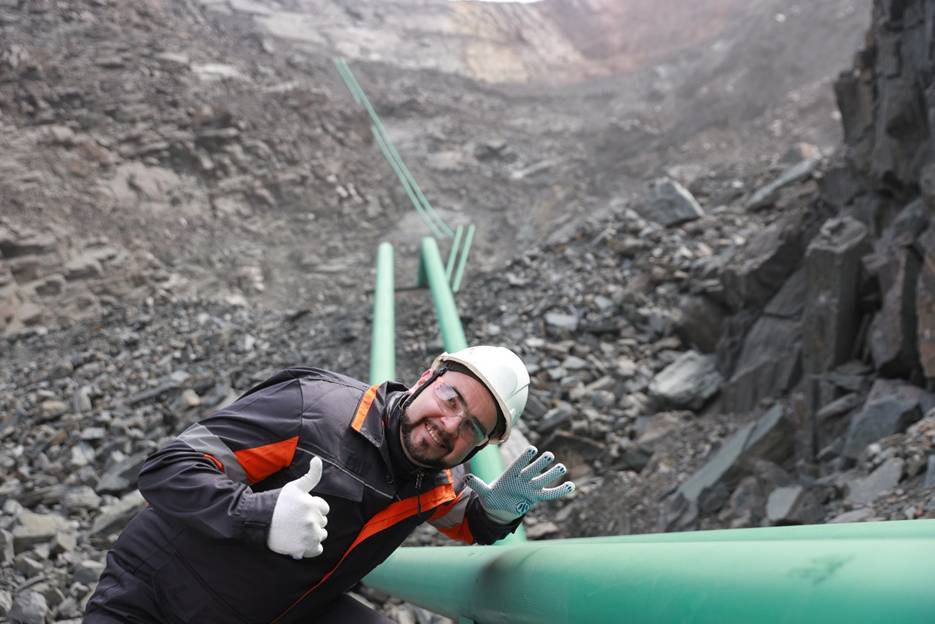
The steel pipes for the project were manufactured at an ArcelorMittal facility in Romania. They are secured on low support blocks, and this height is sufficient to provide welders with access during laying and to enable subsequent repairs to the water mains. The fact that the pipes do not come into contact with the ground will extend their service life. They were laid on both sides of the open pit road along which heavy-duty haul trucks transport ore to the surface. Where iron ore deposits lie beneath the roads and miners will be able to extract them in the future, the pipes run almost vertically along the open pit benches. Enhanced safety measures were applied during installation in such areas, while execution was monitored with the participation of the Occupational Health and Safety Department team, headed by Yurii Dukhov, Head of Division in the Mining Department, and specialists from the Open Mining Department led by Oleh Kravchenko, Head of the Open Mining Department of Mining Department.
The new pipes have been laid to an elevation of minus 45 metres (from the open pit surface), where they tie into the pipeline leading to the surface. As a result, we now have an essentially new, reliable water main. Furthermore, relocating the pipes will give miners access to new blanks of ore in future. And all of us very much need this ore.
The mill is in good condition
A major overhaul of equipment generally entails substantial renewal and considerable capital investment. Despite the company’s difficult financial position, funds were allocated for the major overhaul of one of its principal assets — WR/LSM 250/150-6 rolling mill in Rolling Shop No. 3.
This rolling mill is one of the most important producers of reinforcing bar and round bars, namely our principal commercial products. The repair plan includes a package of work covering every section of the mill — from the charging roller tables to the coil-forming press. Among the principal works, the reheating furnace was relined. Inside the furnace, steel billets are heated to a temperature of 1170 degrees Celsius, giving them sufficient plasticity for subsequent processing. As a result, rolling in the mill makes it possible to obtain products of the required shape. It is the lining that protects the unit against high temperatures.
According to Oleksii Kushnarenko, Head of Rolling Shop No. 3, important repairs were carried out on the furnace’s mechanical equipment, including the beams that move billets during heating, the charging and discharge roller tables, and so forth. Replacing the pipelines used to transport energy resources was of great importance, as was installing new burners to supply fuel. Extensive work will also be carried out on the mill itself. Repairs were completed on the main-drive gearboxes that transmit torque to the rolls. Four powerful shears used to cut steel stock were also repaired.
As part of the major overhaul, the mill guides that retain the stock in the mill and the thermal treatment lines — the main and preliminary lines, which are used to impart the required mechanical properties to the products — were also repaired. The hook conveyor used to transport coils of rolled products and the press that forms these coils into finished-product bundles were substantially upgraded.
“Upgraded equipment means not only quality, reliability and productivity, but also an enhanced level of safety for people, so we have high expectations,” Oleksii Kushnarenko concluded.